
By Vatsala Sperling
Michal Yakir is a botanist, a lecturer in homeopathy and the author of The Wondrous Order of Plants – The Plant Table in Homeopathy. She has developed a comprehensive homeopathic systematics of the plant kingdom that is oriented to the developmental stages of humans.
“The story people tell us is the story of the journey of their soul…” Michal Yakir
VS: Dr Michal Yakir, thank you for being here. You have written a monumental work on plants. Have you found that plant remedies are particularly suitable in certain situations?
MY: For me, 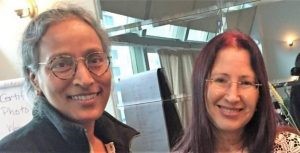 people are not plants, animals or minerals. People are people. When people are ill they express that through symptoms that can be cured by a remedy from one of those kingdoms. In a healthy state they are simply human. I do not believe there is only one simillimum for each person that will help them throughout their whole life. Sometimes people need three, four or more remedies over their lifetime. When I take a case history I simply ask ‘What is bothering you right now?’. I try to understand what is preventing this person from developing further at this moment. I focus on documenting the symptoms, just as Kent and Hahnemann did. I do not view a person as a plant, mineral or animal. They are simply a human being who needs a remedy from one of these natural kingdoms.
VS: In your seminars and in your book ‘The Wondrous Order of Plants – The Plant Table in Homeopathy’ you describe different stages of development and place plants into a coordinate system, in columns and rows, similar to the periodic table of the elements. How does this arrangement help us in remedy selection?
MY: The need for order is deeply human. A periodic table has two vectors. At each intersection of these two vectors we can place one or more remedies. Plants are positioned at these intersections according to their characteristics and attributes. The two-dimensional grid makes it easier for us to allocate and apply plants. The placement of the plants corresponds to a particular developmental stage of the human being. The intersections between columns and rows point to the themes we pass through in our development as humans. Already during the case-taking I try to recognise, from the patient’s narrative, a theme that is important for them and see where it might fit in the table. At the same time I look for the corresponding theme in the botanical families. I also examine the botanical orders to which the plant families belong. It is comparable to the periodic table of the elements. Thematically, human development corresponds to the increasing complexity of the elements in the different rows and columns.
There are overlaps between the plant, mineral and animal kingdoms because they all arose according to fixed laws of nature. Our Materia Medica is subject to the same regularities and is therefore also built according to a particular logic. There are overlaps between the plant kingdom and the minerals, but we cannot translate them one-to-one. The periodic table of the elements contains only 118 elements, whereas thousands of plants have been categorised in the plant table. For that reason alone one cannot map plants one-to-one onto minerals. In the plant table the emphasis is on botanical families and orders, and here there are similarities with the themes of the elements from the periodic table.
VS: What inspired you to study and classify plant remedies?
MY: As a young woman I had to do my military service in the nursery of a kibbutz. There I fell in love with plants. Afterwards I went to university and graduated in botany and ecology. I wanted to use my knowledge for other people and so I studied homeopathy. That was 30 years ago, when Jeremy Sherr and Jan Scholten were teaching in Israel. I could follow the logic of the periodic table and as a botanist I instinctively knew there had to be a logic for plants too. I began to examine plants and homeopathy more closely and gradually collected information about the plants piece by piece. It took 15 years to assemble all the information into a coherent system in which the therapeutic action of the plants harmonises with the botanical and ecological characteristics.
To answer your question – I was inspired by my love of plants and by my wish to use my knowledge for the benefit of people. When I began teaching this classification of plants I received a lot of feedback from my students and the idea came to me to compile everything in a book. The Hebrew original is already in its 7th edition. The first book had 85 pages; the 7th edition comprises 450 pages. In English it is an 850-page tome.
VS: In what way can plants mirror the development of the human being?

MY: Plants do not only develop according to the laws of nature; they make the development of the Earth itself and all its life forms possible. Our universe was formed in a spiral and follows certain natural laws, namely the spiritual laws of creation. Evolution occurs slowly, a stepwise development stretching over millions of years. Things are born and ripen. Then they become a platform on which new life arises, grows and matures. This development continues ever onward, it is a continuous process… first minerals, then simple life forms, then simple plants, fungi and animals, until life forms gradually become increasingly complex. Because of this, all life forms can receive support and help from other life forms, as they are all part of creation.
The natural laws from which these life forms emerge also include the aspect of gender, that is the feminine or masculine aspects of primal substance. This is one of the differences between minerals and plants. Minerals, as far as we know, do not have sexuality. Plants have sexuality and the whole plant table moves between the feminine and masculine principles. It is based on the interplay of these two creative forces and the emotions they trigger. At the beginning of creation the feminine principle was dominant, because it was mobile enough to receive and take in the masculine force. The masculine element, by contrast, stands for hardness, barriers and separation. Plant remedies embody these two creative forces because they essentially arose from the interplay of these powers. Plant remedies can therefore help resolve issues that involve an excess or a lack of femininity or masculinity.
Just as plants have developed from simple to complex forms, humans develop from the prenatal stage through to old age. In this developmental span the interplay and expressions of the feminine and masculine forces can be seen very clearly, just as they can be observed in the evolutionary history of plants.
VS: To pick up again on the increasing complexity of plants, which classification system do you use in your table?
MY: My plant table is based on the morphological features of plants as opposed to genotypic classification.
VS: How can we apply this new understanding of plants and plant remedies in practice using this table?
MY: The plant table is very helpful in practical application. It is an approach that unites all developmental processes we know – personal, interpersonal, social and even cultural aspects that we can observe in humans. This approach also considers the chakras and the mythological process of origin. All these developmental processes can be regarded as continuous processes and that helps us to understand a case in its totality.
 One takes the case, places the themes at the corresponding place in the Plant Table and immediately knows where the case began, how it has developed and where it is going. I have observed this myself, even in cases where I had to prescribe a very small and rather obscure remedy. Because the Plant Table covers all the aspects of development I have just mentioned, I can understand a case in its entirety even when a particular small remedy is indicated. Although in a case there may be only very simple and sparse information and the corresponding remedy picture is incomplete and there is no provings, the placement of that remedy in the table can help close the gap in information. In the table we also find information about the botanical family and the order to which that small remedy belongs. This detailed information helps us to understand the case in its totality and to gain a deeper understanding of the psychological aspects of a patient, their life, their history and the healing they need. The information can be derived by using the Plant Table to see which developmental stage the corresponding order/family fits into.
When we deepen our own understanding and adopt a more inclusive view of plants in the various developmental stages, the story behind the patient is no longer just a big mystery. The story then reflects human development and can be linked to the evolution of plants as described in my table.
About Vatsala Sperling:
Vatsala Sperling RSHom (NA), CCH, MS, PhD, PDHom, was Head of the Department of Clinical Microbiology at the children’s hospital in Chennai, India, where she researched extensively and conducted projects with the WHO in Denmark. After moving to the USA to raise a family she studied homeopathy at the Micha Norland homeopathic institute. She is the author of eight books (www.InnerTraditions.com) and has published numerous articles on homeopathy, spirituality and health. Vatsala practises in Vermont and continues her training, among others, with Drs Bhayisha and Sachindra Joshi. She was active in the North American Society of Homeopaths and currently volunteers for the Council for Homeopathy Certification. She can be contacted via her website www.Rochesterhomeopathy.com.
----------------------------------------------------------------------
Originally published in www.hpathy.com : Homeopathy 4 Everyone, May 2018

