
Menopause and the change of life? For many women, homeopathy is a lifeline.
By Joette Calabrese, HMC, CCH, RSHom(Na)
“I love colours,” says Isabelle. “As a child I loved pink, but as I’ve grown older I prefer red. It’s the colour of blood and vitality – the rosy red of life. But red is also the colour of the splendid pageantry of Christmas and the bright red of a sports car.”
Isabelle is 60, raised five wonderful children and has been married to the same man for over 35 years. (“He’s very happy with me,” she says, but is discreet enough not to go into details.)
Isabelle’s zest for life shows everywhere: in her speech, her clothes, her house and her relationships she sparkles with liveliness. There is nothing, absolutely nothing, dull about this woman. She is a woman who has her life firmly in hand even beyond the change of life.
It wasn’t always like that, because 15 years earlier this strong-willed and self-confident woman had found herself in the midst of the change of life and did not recognise herself. She was shaken to her foundations and no longer herself. Her skin became dull and flabby, her usually good figure needed coaxing back into shape, and her mood swings had become almost legendary.
Isabelle’s husband tiptoed through the house and even the cheeky little family dog, otherwise a rather daring terrier, cowered away as soon as his mistress came near.
“I was wild and defiant and desperately needed taming. The doctor I consulted in my distress, however, believed that everything could be sorted out with medication.”
Isabelle continues: “She was like a walking pharmacy: hormones, patches, sleeping pills, antidepressants. I was foolish enough to take the stuff. I thought I had no other choice. I remember clearly when the doctor explained that the medications would regulate my hormones again. She said there was no other way.”
After months of this “drug therapy” – Isabelle now calls it a contradiction in itself – she sank into a state of emotional numbness that stopped her from taking part in life. Her doctor told her the antidepressants would relieve the anger and depression.
Which was not entirely true.
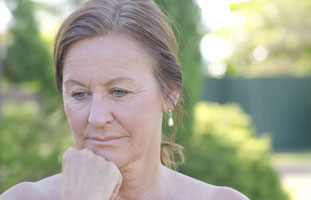 As if she had made a pact with the devil, Isabelle had to pay a high price. What her doctor had not told her: Isabelle felt as if her personality had been cut off, her feelings switched off by lobotomy. She was no longer hysterical but sentimental and sluggish. She was no longer depressed, she could simply feel nothing at all.
When her daughter-in-law happily announced she was expecting her first child, Isabelle showed little interest and responded with a neutral, “Oh, how nice.” Should I emphasise here that Isabelle’s family became increasingly worried? Strangely, no one thought that the strong medication might be the reason for the marked change in personality, because everyone had the utmost confidence in conventional medicine. Sure enough, the doctor would not prescribe anything that would cause such side effects.
That trust was permanently shaken when the family spent the summer holidays at the seaside and Isabelle forgot her medication at home – whether deliberately or not, nobody really knows to this day. That was the moment Isabelle came back to herself and was able to turn the tide. It was not easy, because first came the withdrawal symptoms: mood swings, sleep problems, vomiting. The family accepted all that, because at the same time something wonderful happened – for the first time in a long time the family had the old Isabelle back. The happiness was short-lived, however, because with the old Isabelle came the fits of anger and the depression in intensified form, and it very quickly became clear to everyone that another solution had to be found.
Fortunately for her, Isabelle spoke shortly afterwards with her neighbour Sarah, who told her about a homeopathic remedy that had helped her greatly during the change of life. She had a bottle left at home, just in case, although her own menopause was many years behind her. Would she like to try the remedy?
“My homeopath told me to take the little pellets once a day for 13 weeks. After just two weeks I noticed a change,” Sarah recounted. “I was myself again, without all those terrible symptoms.”
Isabelle of course took the remedy immediately. She was familiar with homeopathy and had successfully treated one or another infection in her own children with pellets. What she had not realised was that these small, unassuming things would also cope with formidable menopause symptoms such as fits of anger and depression.
It took less than four weeks and Isabelle’s husband noticed that his wife had regained part of her gentleness. She could now laugh at his teasing again, took an increasing part in life and had noticeably more energy because she slept better. In short: she was almost her old self again.
The miracle remedy is called Ammonium carbonicum C200. It is a specific for the time before, during and after the menopause. The starting material for this remedy is ammonium carbonate, also called hartshorn salt or smelling salt. In homeopathic preparation it is a very effective remedy for complaints during the change of life. Thousands of women have been helped by this medicine alone at the Prasanta Banerji Homeopathic Research Foundation Hospital. I was fortunate enough to be able to witness the first-class effect of the remedy on site.
Ammonium carbonicum is also used for chronic tiredness, mental sluggishness and menstrual complaints. Dr Margaret Tyler writes in her book Homeopathic Materia Medica: “It brings relief in fainting fits or other neurological or circulatory symptoms, including palpitations during the menopause.” Particularly interesting to note is that Ammonium carbonicum is derived from smelling salts. Dr James Kent describes the remedy in his Complete Homeopathic Materia Medica: “The menstrual blood is blackish, often clotted.” Sharp leucorrhoea. “Severe tearing in the abdomen and in the vagina.” Soreness of the entire pelvic organs; sometimes the patient feels as if all the pelvic organs are raw or sore.”
I have also observed that this remedy can revive long-standing marriages that are threatened with collapse because the woman insists on finding herself again, declaring her husband unattractive and being determined to separate. I have often found that a woman in the hormone-driven up-and-down of the change of life is difficult to persuade with logical arguments. Many women simply no longer listen to their healthy gut feeling, but are driven solely by their uterus. After a course of several weeks with Ammonium carbonicum, in many cases a change of mind can be observed that has already saved many relationships. It usually takes three to four months until the woman no longer longs exclusively for a life that belongs only to her and in which the supposedly completely inadequate husband absolutely has no place. Gradually she recognises that there are indeed positive sides to her partner and the relationship that are worth appreciating and loving.
In Isabelle’s case her passionate, cheerful nature had been suppressed beyond recognition by the antidepressants. Her personality was in danger of breaking; indeed, the medication was in the process of destroying the whole being of this woman. Had homeopathy not been at hand to restore balance, it would probably have been better for all concerned to endure the mood swings and fits of anger in the months and years to come rather than accept the devastating effects of the medication. For another woman whose emotions are not expressed so exuberantly, these medications might perhaps have eased the mood swings, but probably only to pave the way for a depression. Do we really want that, to subject our lives and our biological clock to an artificial, because chemical, control? I don’t think so.
I like to compare mature people with sublime and dignified architecture – behind the partly weathered façade lie unsuspected treasures. We can accept the challenge and become rulers of our innermost mysteries, or submit and be ruled by an industry that has by now completely run out of control. If a man or woman wants to oppose the apparently impending decay, one can do it playfully and with humour; there is nothing wrong with shaping pants and smart supportive bras. But taking medications that are anything but harmless? That in many cases turn out to be forgeries? At our age the desire for authenticity grows so great that we are happy to accept a light patina, as long as the soul behind the façade remains intact.
Diana Vreeland, who became editor-in-chief of Harper’s Bazaar at the age of 60, once said: “There is only one good life and that is the life you imagine for yourself and which you realise according to your own ideas.”
Nature never intended to turn this time of transition into a battlefield. Homeopathy supports the body during this important time and helps us women to navigate the currents of life without running aground. It lets us take things into our own hands.
This morning Isabelle painted her toenails bright red: “I love it when my red toenails gleam in my sandals,” she says. “It reminds me how exciting and dynamic life can be.”

