
Lepomis gibbosus: the Great Lakes proving of the pumpkinseed sunfish pumpkinseed sunfish |
|
The "pumpkinseed" is a freshwater fish found in the northeastern part of the USA from New Brunswick to South Carolina; in the New York area it is the most widespread and common fish; it is also encountered in many other parts of North America, especially in the Great Lakes region. The pumpkinseed was also introduced to Europe and is widely distributed there. Aquarists originally imported it because of its ornamental patterning and attractive colouring. |
|
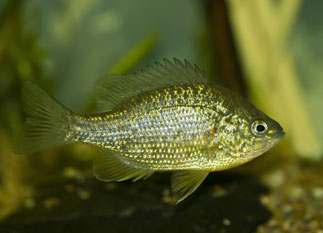 |
Natural history: These fish reproduce rapidly and occupy a fairly low position in the food chain. They eat a wide variety of insects, e.g. mosquito larvae, and small molluscs and crustaceans. They also feed on smaller fish and even display cannibalistic |
behaviour, by eating smaller pumpkinseed sunfish. In the shallow waters they typically inhabit, the fish can be found at all depths from the bottom up to just below the surface. The fish in turn serve as food for birds and mammals (including humans). The pumpkinseed sunfish has adapted to its environment in several ways. The patterning on its skin provides camouflage in the wild, as it resembles the patterns created by sunlight on ponds, lakes and streams. This clever fish has also developed a special protective feature: along the dorsal fin it has ten to eleven spines and three on the tail fin, all very sharp and offering some protection against predators. |
|
|
|
Louis Klein taught us that cannibalistic fish make good remedies for Alzheimer’s and other brain diseases. Fish are known as "brain food" because of their high content of omega-3 fatty acids, but that is |
|
not the only reason for this connection. Cannibalism is widespread among fish, and the link between prion diseases and cannibalism is known (e.g. kuru, mad cow disease and chronic wasting disease). Some researchers postulate a connection between prion diseases and other types of brain pathology such as Alzheimer’s and Parkinson’s because of the similarities in brain protein malformations. In this remedy the psychological symptoms of Alzheimer’s and similar brain disorders are particularly present, especially problems relating to memory, concentration, speech and comprehension. The unique characteristic of the remedy is a hidden cruelty behind the façade of a "sunny" nature. - Headaches and dizziness - Stomach / digestive disorders, nausea - Limbs: numbness, tingling, burning, pain - Sleep disturbances |
|
Photos: Shutterstock |

