
by Sonja Obbink

Case 1: a 60-year-old patient with sleep disorders
Mrs X. comes to the consultation because of her sleep problems. She suffers from palpitations and therefore cannot sleep. She is exhausted and feels "burnt out". She wants to become more balanced and strengthen her nervous system because she has become very nervous since her divorce.
She was married to a man she describes as "the love of my life". She repeatedly talks about how much she loved him. The birth of their daughter was complicated. The second child had to be delivered by caesarean section. The child was not fully developed and was multiply disabled, so it died shortly after birth. The patient "saw" her baby while she was anaesthetised – a sign of this woman's sensitivity. She is a highly sensitive person.
The patient lived abroad for a long time with her husband and child. Her husband had a relationship there with another woman, with whom he also fathered children. The patient could not live with the situation and filed for divorce – a step entirely against her nature and very difficult for her. She loved her husband very much. Now she has to live alone; having a daughter helps her a lot with this, because she must build a future for herself and her child. The separation from her husband was very painful for her, but she wanted to show her daughter that she could cope with the situation.
Even now the patient experiences the loss of her beloved husband as very painful. Thinking of him or hearing his voice on the phone hurts her. Her weakness is the readiness with which she gives without asking for anything in return. She is very creative – she sings, paints and writes poems. The highly sensitive woman perceives many vibrations from other people. She also reacts sensitively to electromagnetic radiation. She is constantly on guard against an accident; she can literally feel the threat in her body. Her bones feel as if they were constantly charged.
Family
The patient comes from a very religious family; both parents studied theology and worked as pastors. She had a brother with Down syndrome who died at the age of 50. The diagnosis was made when her mother was pregnant with her, at the beginning of the Second World War: "Bombs fell on my cradle." There was no security and the parents hid to avoid deportation. Because the mother lived in constant fear, the patient is convinced she absorbed this through her mother's milk. The father left the family for another woman when the patient was eight years old. The mother became a "wreck" and suffered from a borderline personality disorder with severe mood swings – she could be loving and kind one moment and very aggressive the next. The patient felt responsible for keeping her mother's life in order and for earning her mother's love: "Love must be earned." She took on responsibility for her mother and brother. She had a close bond with her mother-in-law and inherited a small fortune, which helped her make ends meet financially after the divorce.
The patient feels lonely. She withdraws and walls herself off. This behavioural pattern was established early because she had to replace the father and care for her mother. She tried very hard but always felt not good enough. Later she felt the same towards her husband. She gave herself to him with all her love; she "could not hold him". She withdraws. She describes herself as an individualist but does not feel comfortable with it because she actually wants to belong. She feels as if she has been "disposed of".
The great sensitivity and receptivity of the patient give clues to the plant kingdom. Many properties of the carbon series are present: the feeling of threat, the struggle to survive, the lack of security; the mother's personality disorder; love must be earned. Phase 3 is clearly visible because she sacrifices herself for others and does not feel she belongs; no matter what she does, it is never enough. These characteristics lead us to the Magnoliidae, phase 3 – the Canellales – and finally to Drimys winterii.
Previous remedies
Natrium sulphuricum: The patient still feels connected to her ex-husband. She tells how much she still loves her great love. She cannot let go. After taking the remedy she slept deeply and soundly for two nights. Then she contacted a spiritual healer who helped her energetically.
Holmium oxydatum: withdrawn, spiritual. Oxydatum: dishonest, feels pushed aside, used, a victim. After taking the remedy the patient feels freer.
Thulium oxydatum: misses her husband and the sun; discouraged; feels judged, it causes her pain. After taking the remedy she feels lighter, as if she were floating.
All remedies show an effect, but none heal deeply and permanently. The patient's voice still has something plaintive when she tells her story. It gives me the impression that I have not yet reached the core of the case. At this time Jan Scholten presented his theory of the plants for the first time. When I revised the case, I noticed that the patient's ex-husband had many similarities with her father. She felt split into two parts, abandoned, lonely and sad. She walled herself off and sought protection behind a barrier. At the same time she strives hard to belong, which she does not really succeed in. According to the plant theory the Magnoliidae are indicated here: the cause of her problems lies in her family of origin.
Prescription: Drimys winterii
Follow-up
The day after taking the remedy the patient feels 100% calm – in body, soul and mind. She takes the remedy weekly; it gives her strength and a deep sense of balance. "I have closed the chapter on my past!" She has tried so many things to help herself; the path was very long and now she has succeeded. She has been well for one and a half years.
Case 2: a patient with depression
The 30-year-old patient comes to the consultation because of chronic fatigue and depression. She sleeps poorly. She withdraws from the outside world because it takes more and more energy to turn outward: "this pressure and this stress." She perceives her life as a constant struggle. She sees herself as an outsider, someone who observes. She finds it difficult to set boundaries and is ashamed because she has not made anything of her life so far. The patient is the youngest of four siblings; she has two sisters and a brother. One of her sisters (the third in the sibling order) suffers from bipolar disorder and schizophrenia. She herself has already had a psychotic episode, in which she had delusions – she believed she had to poison her mother. In secondary school the patient did not feel well; at that time she suffered from sleep disturbances and was hyperactive. At that time her parents gave a lot of attention to the eldest sister and the patient felt excluded and neglected. She constantly compared herself to her sister and had to fight hard for her own identity. There are several cases of depression in the family: the patient's nephew took his own life because of it and her father is manic-depressive.
Recently a long-term relationship came to an end. The patient has a new job and is very afraid of making mistakes there. The situation causes a lot of stress for her. She feels very tired and sluggish, often just lies in bed and watches TV. She suffers from mood swings: in the depressive phases she feels very lonely and sees no prospect for her life; she cannot cope very well on her own. Her flat is chaotic; she cannot structure herself well and does not have her life under control. For this reason she clings to other people: she finds it hard to bear when friends or partners want to do something alone. During the anamnesis I notice that the patient is constantly seeking support: she talks a lot and is always looking for a solution, which she cannot find.
Analysis
The following factors point to the carbon series: feeling small, dependent, clinging to others, alone.
The problem has its origin in the family of origin: carbon series, Magnoliidae.
Prescription: Drimys winterii (winter bark).
Follow-up
After taking Drimys the patient felt very tired for a short time, after which she had significantly more energy than before. She was able to return to work and found the support she needed there. She can concentrate better and interaction with other people is easier for her. She no longer feels so excluded when someone in her circle of friends wants to be alone. She has also re-established contact with her sister with schizophrenia and can communicate with her without losing herself. Previously she could not manage this. She started singing and dancing again; she looks lively and fresh. Fatigue and depression seem to have been swept away. The patient has been well for over a year.
*****************************************************
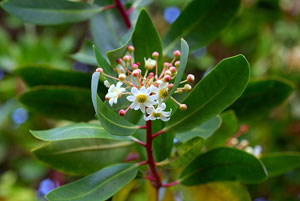
Photos: Wikimedia - Drimys winteri (winter bark) © Eric Hunt
Shutterstock - alone - © Denis Rozhnovsky
Category: Cases
Keywords: sleep disorder, palpitations, exhaustion, highly sensitive, alone, divorce.
Remedy: Drimys winterii.

