
Downtrodden and humiliated — or the desire to be someone great: Insect and spider remedies
Of all the animals on earth, insects and spiders are almost everywhere the least liked by humans
(only the archetypal fear of snakes is comparable — in our imagination they are symbols of the underworld).
Spiders make us spring up in panic, and our heart rate accelerates. Although the neurotoxin of a spider bite is rarely fatal to humans, intense phobias occur. Panic attacks can lead to palpitations or, through psychosomatic anxiety, even trigger angina pectoris. This is related to the effect of spider toxin on the central nervous system, which causes pain, paralysis and increased heart rate. With spider bites the negative effects — the paralysis or sepsis — take longer to become effective.
Insect stings cause irritation,
itching, allergic reactions and swelling. In some cases the
allergic reactions can trigger an anaphylactic shock and quickly lead to death by suffocation. Therefore insect remedies have a fear of
sudden death and suffocation.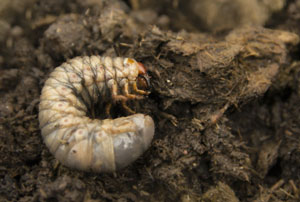
Dirty and disgusting
People loathe insects because they believe they contribute to the spread of disease; mosquito bites cause malaria,
flies spread infection. Being dirty or unclean is an insect theme, especially with regard to Musca domestica, the housefly, which feeds on
excrement and then settles indiscriminately on food. Maggots are an image of rubbish and rotten food, and we
react with disgust. This feeling of disgust — they might say, for example, “everything is rubbish” to describe their life circumstances — and their outrage that they feel “treated like dirt” is typical of the remedy picture of Musca domestica.
To cope with their sensitivity to dirt, people who need an insect remedy
can be more fastidious than an Arsenicum case regarding cleaning, tidying or vacuuming (sucking with a proboscis is a typical insect behaviour).
Humiliated
and degraded
Insects are considered pests that must be exterminated (fleas,
lice, bedbugs, flies, mosquitoes). They are hard to get rid of, and their
persistence is irritating. The presence of a wasp or mosquito nearby
makes us feel annoyed, and in insect cases the patient can feel
harassed (malaria miasm), humiliated or insulted.
Ruthless
There are about a billion insects per person on this earth. Insect societies
are tireless; they enslave the workers of a defeated tribe in the ruthless effort to colonise new land, and exploit them with cold,
rapacious ambition. This is the success model of entrepreneurial strategy —
also in human life — from exploiting mineral resources to patenting seed for food crops. So it is not
surprising that we find the insect consciousness increasingly in many cases today.
Jonathan Hardy, an English homeopathic physician who teaches about spider and insect remedies, says they represent an ordered, structured sequence of a sub-kingdom. He notes that people who need an insect remedy often initially give the impression of belonging to the mineral kingdom, because structure and organisation are very important to them.
Competitive behaviour
Ambitious, industrious, always striving for improvement and progress to compensate for an inner sense of inadequacy (which can be mistaken for lack of
competence in the mineral sense) — in insect cases performance is a means of validation.
In an insect or spider case there will
always also be competitive behaviour — as a central theme of the animal kingdom —
present. One is the winner and one the loser. Mineral remedies can also show issues of performance or problems related to attack and defence; but when the person feels like the victim of a predator, or when there is obvious competitive behaviour, this is a typical animal-kingdom struggle for territory and survival.
Nevertheless this is sometimes not so obvious. A butterfly case may
be occupied with its identity. An Apis case may be concerned with organising all household members and keeping them employed.
Social organisation can be a more important theme than survival.
But eventually we do discover competitive behaviour. In insect cases
this is often overlooked, minimised, disparaged or ignored.
Disrespect
and deception
Spider cases do not tolerate disrespect. Against a power imbalance or
unfair treatment they fight back with determination. The distinctive trait
of the spider remedies is a provocative and disrespectful humour; with tricks
and jests they “play” on their victim. The web that catches a spider’s prey is sticky and almost invisible.
The “spider deceit” may be associated with the artful, complex web of ultraviolet silk that a cross spider spins, which mirrors the pattern of a flower to lure an unsuspecting insect, while the ground-dwelling spider camouflages its hole like a trap with leaves or twigs, and jumps up to seize its prey.
Restlessness
Spider remedies are internally restless and cannot sit still, they fidget,
often suffer from restless legs and must keep their hands constantly occupied (knitting is a spider hobby). Spider remedies are sensitive
to noise and sounds and feel all the vibrations that resonate in their body. Spiders have a sense of rhythm, like to dance and jump around,
but can also show weariness and exhaustion (modality: better when lying down). The rhythmic qualities extend to the periodicity
of complaints, e.g. headaches recurring yearly or monthly.
Insects are constantly moving and buzzing about. People who need
an insect remedy sometimes have the feeling of energy humming within them. They are always busy, work hard and achieve a lot to reach their
goals, or they engage in equally hectic and fruitless activities.
They
are ambitious and want to achieve
A feature of the spider remedies is that they want to be significant.
Insect remedies are ambitious, they want to achieve, are often materialistic and fear poverty.
Insects live in highly organised social groups with defined roles; they can form structures and build “cities”, or eat and destroy everything in their path. In humans who need an insect remedy this is expressed in a materialistic attitude. They can be enthusiastic consumers and must always have the latest gadget; they care a lot about their appearance, wear fashionable brand clothing and use hair-styling products or make-up.
Transformation
Their ambition is driven by an innate feeling of inferiority, they push themselves constantly to even greater achievement, even when they are already successful. They constantly strive for self-improvement. Central themes in insect cases are change, transitional situations or a complete transformation of their life circumstances. Their desire for progress relates to the transformation from a low, earthbound caterpillar to flying — to the point where their life or their project begins. They pursue their goals ruthlessly.
Power struggle
Insect and spider remedies have problems with control and domination. Wasps
lay their eggs inside other animals, such as caterpillars; ants can
enslave other ant colonies. This explains why some insect remedies
have the delusion of being “under superhuman control”.
Spider remedies, however, often carry out their power struggles in relationships and
prefer to leave decisions to a stronger partner, as illustrated by the
delusion “my head belongs to someone else”.
Male spiders are smaller than the
females; the themes “bigger than me / smaller than me, stronger than me” etc.
have a key function in spiders. Insect remedies often feel small
or insignificant, they have an inferiority complex, they feel
devalued or worthless because of the treatment by others. Spider remedies engage in power struggles, and have the impulse to turn the tables or take revenge on the superior person. “Being bigger” in spider cases refers to the peculiar delusion of enlargement of body parts.
Neglected
or possessive
Insect remedies can have the feeling that they were treated coldly and unemotionally by their
parents in childhood. Apis is an exception;
honeybee larvae are fed and raised by the workers, and the sexual drive in Apis is sublimated in the form of duty. But other
insect remedies tend to feel neglected by their parents.
Spiders give parental care to their young,
and male spiders sacrifice themselves as food for their offspring. In
human relationships this “self-sacrifice” can manifest as overprotection.
The close bond can lead the child to have to escape the possessive
love of their parents. A spider remedy (especially the “black widow”) can be indicated in a case where a parent is needy,
demanding, controlling and manipulative.
Animal remedy cases always portray the predator and its prey. Spiders are
cautious in their mating dance, because if they become entangled in the web they risk
being bound, losing consciousness and becoming paralysed, and their life sap being
sucked out of them. Yet they cannot resist engaging, and once engaged they fight to free themselves from the situation.
Spider and insect remedies show restlessness and have high sexual
energy. The sexual drive of insects is intense, but it can also be only an
affair. In spider remedies what begins as a demand for constant attention can develop into manipulation. Alize Timmerman
describes the dynamics of possessiveness in the under-kingdom of spiders — the possessive
partner experiences intense despair because they cannot live without the other.
They develop psychosomatic
panic symptoms with colic-like pains in the heart area,
exhaustion or depression. The need for attention and the
sexual drama act destructively. If their partner tries to leave them,
the manipulative “victim” declares: “I will take everything he has.” Latrodectus mactans, the black widow, can be a remedy to free both parties from the destructive
pattern of a vengeful and bitter divorce.
This article was published on www.interhomeopathy.org.
Photos:
Rhinoceros beetle larva in the ground; © www.shutterstock.com - VICUSCHKA
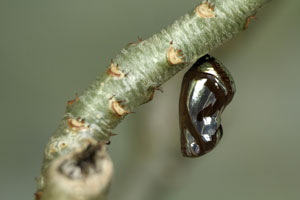
Common Indian Crow Pupa hang on Desert Rose; © www.shutterstock.com - MotionLight
Category: Families
Keywords: activity, restless, weak, humiliated, offended, respect, transformation, anaphylaxis, angina pectoris, palpitations, inflammation, manipulative, possessive, insect, spider
