
1. By Compton Burnett:
I have for years repeatedly dealt with the subject of the homeopathic treatment of cataract. As I have in my practice succeeded in several cases in either curing or alleviating the disease, I have, after careful consideration, decided to publish this text. Originally my intention was to wait to publish my observations until I could comprehensively and by means of many cured cases prove that cataract is curable and thereby convince ophthalmologists of the facts I had established. However, being aware that the expectation of a flawless proof all too often ends in unproductivity, I will not delay publication any longer.
Harley Street, London, W.
J
J.C. BURNETT
|
As my 33rd reason for being a homeopath, I would like to present a case of cataract that could be cured homeopathically. You wrote in one of your letters that you would like to meet the man who succeeded in treating a case of cataract medicinally. Very well, I will now report how I was able to satisfy myself of this. In reply to your question whether cataract can be treated medicinally, I answered that apart from a single case I had no personal experience and was of the opinion that one could not expect—considering the nature of this disease—to be able to cure it medicinally or even to alleviate it. After all, there were several homeopaths who reported such cases and others who confidently asserted they had cured cataract with homeopathic remedies. |
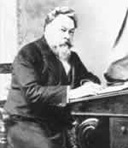
James Compton Burnett |
My patient took from 29 May to 19 June 1875 Calcarea carbonica C30 and Chelidonium C1, one globule three times daily, always alternately. Thus she took two doses of Calcarea on one day, only one the next day, and vice versa with Chelidonium.
There were indications for both remedies, although I can hardly justify the alternating dosing: I very much hope that I no longer prescribe alternation so often.
Then followed Asafoetida C6 and Digitalis purp. C3.
Subsequently Phosphorus C1, followed by Sulphur C30 and then Calcarea and Chelidonium.
I prescribed in this sequence Phosphorus, Sulphur, Chelidonium, Calcarea carbonica, Asafoetida and Digitalis until the beginning of 1876.
On 17 February 1876 I prescribed Gelsemium C30, one globule three times daily. The treatment was continued in this way for a month.
Thereafter I prescribed the following course: Silicea C30 for 14 days; Belladonna 3 for 14 days; Sulphur C30, three times daily for one week; and then Phosphorus C1 again for 2 weeks.
 One month after that date – it was 20 March 1876 – one morning I heard loud talking in the corridor and my patient ran into the practice. She was excited and told me loudly that she could almost see as well as before. She went on to explain that recently she had been seeing better and could recognise objects and even people in the street. She nevertheless thought it might be imagination until this morning when she was able to see the parting in her hair clearly. She immediately came to tell me and had further tested her newly regained sight on the way here by reading the names of all the shops, which had previously been impossible.
I at once prescribed another course and two months later the opacities had completely disappeared. The patient's vision was restored and remained exceptionally good thereafter.
This case caused great attention locally and as a result I was able to attend to a number of cataract cases. The good outcomes of these treatments are in any case very encouraging.
2. By Henri Voisin:
|
Excerpt from the Repertory for the Homeopathic Practitioner by Henri Voisin. Homeopathic treatment generally achieves a slowing, often a halt and occasionally a regression of the lens opacity. It should include: 1) Eye drops with Cineraria 1:20, Cortiso. C12-30. Arthritis – Caust. C5-6 (chilly, not nervous), Mag-c. C5-6 (nervous and chilly). |
Henri Voisin |

Asthenopia – NAT-M. C5-6.
Diabetes – Phos. C6.
Eye inflammations – Cann-s. C5, Euph-re. C5, Kali-s. C4-5, Nat-m. C5-6.
Menopause – Lach. C5-6.
Sclerosis (general) – Caust. C5-6, Thiosin. C4.
Old people. Senility – Caust. C5-6 (paralysis, wasting), SEC. C5-6 (chilliness, ischaemia), SIL. C5-6 (sensitivity to cold), Seneg. C5 (ocular paralysis, vitreous opacities).
*****************************************************
Copyright:
Photos:
Shutterstock - Close up of the mature cataract during eye examination © ARZTSAMUI

