
We were asked to make a house visit to a patient with dry gangrene on both feet. The man had been told that amputation was the only way to save his legs. Surgery was not an option at that time because a Doppler sonography had shown that the lower extremities were barely perfused. Under the circumstances it was decided that two of our experienced doctors would examine the patient at home the next day. The patient was bedridden and his wife opened the door for us. The first thing the two doctors noticed was that the second and third toes on the left foot were already dying. The big toe of the right foot was also in poor condition and would shortly die as well. Both feet were blackish in colour with fungal infection at the gangrenous sites. The wound was extremely repulsive. The feet felt cold on examination and the pulse was not palpable.
On further questioning it emerged that the patient had been diagnosed with diabetes mellitus ten years earlier. He had had peripheral neuropathy for seven years. He had also had high blood pressure for seven years and a residual hemiparesis for four years with two strokes. Signs of early-stage Parkinson’s disease were apparent, as well as lens opacity with haemorrhages into the vitreous and glaucoma. The patient was under great stress and had sleep problems. In January 2012 the pain in the toes began; at that time a nail fungus was diagnosed. As part of his treatment protocol he was to take medication and maintain strict personal hygiene. Due to his own neglect the complaints, however, worsened. The wound deteriorated and he had to have the dressing changed every other day. Fasting blood sugar climbed to 240 mg/dl. At that time he was given oral insulin; later he had to inject three times daily. In addition he took medication for high blood pressure and Ayurvedic preparations.
The pain became increasingly unbearable and the patient anxious and demanding: “Give me something for the pain at last.”
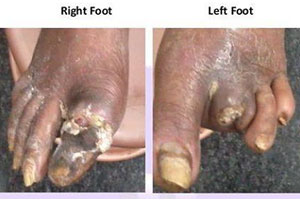
Medical history – the wife reports:
Eight years ago my husband was exploited and cheated by his family. He had a hotel together with his father and his uncle. He spent all his money on his three sisters and his family. When his mother died in 1995, he was thrown out of the business by his uncle. He did not resist at the time; he simply came home and cried. It was a big shock for him; he was 53 then. He had a nervous breakdown. His whole behaviour changed: he would just sit and stare, always at one spot. At that time he developed large pustules all over his body, with crusts and filled with pus. Because of this he had to be hospitalised seven times. At that time the lead levels in his blood were very highly elevated. His mother’s death did not affect him so much, but when he had to leave the firm because of his uncle, he began to wonder whether he had made a mistake somewhere. He thought he was to blame for the whole thing. At 54 diabetes and high blood pressure then appeared.
He subordinated himself unconditionally to his mother and his sisters. He never questioned them. It took six months before he recovered from the lead poisoning; only after half a year did the lead levels fall. He had financial problems and was very depressed.
In December 2006 he received a complaint from our daughter-in-law about her dowry. She claimed not to have received enough dowry and wanted more money. But it was all fabricated. The case is still ongoing. There is even an arrest warrant against us, with no possibility of bail. Our daughter helped us a lot and we were able to spend three months in exile. Up to that point he had only had diabetes mellitus and high blood pressure, but now his blood sugar shot up to 350. Since December 2006 he cries constantly and withdraws. When we ask him what is wrong, we get no answer from him. For four weeks he has had hallucinations and says: “They ruined us. I never had a family life. I was cheated. To hell with them.” Once he sat on the sofa and said: “I am on a platform and I will not leave the lawyer, the DAUGHTER-IN-LAW and her father. They must go to prison for five years, you see, they are in prison.” He felt guilty. He had by then become convinced of his guilt.
In the patient’s own words
“I do not react to anything any more. My mother made me what I am. I used to pray a lot. I showed no reaction, only smiled quietly. My mother was good to me.
“At sixteen I started working, after my father’s death. I am a rather meek person; I do not get angry. I have never had an argument with anyone. If someone wants to start a quarrel with me, I remain calm and do not react. When others ask after my wellbeing, I always answer that I am fine. I had a good childhood. I am the eldest of five siblings. I studied law, but never worked as a lawyer. My mother asked me to join the family business, a hotel. I was cheated by my own relatives because I never stood up for myself. I am not shrewd. No one was strict and I made sure my sister could study and get married. I always subordinated myself and never took money for myself. I told my uncle to support my mother financially (weeps). I never asked my mother for money.”
Patient’s temperament according to his wife
“He never looked after his family. He is very suspicious. When I pray he accuses me of hypocrisy. He demands that everything be done immediately, otherwise he becomes aggressive and demanding, shouting at me and our son. ‘Damn it…come here now, I need to pass water.’ ‘What is this – give me cold water. Can’t you make the water cool?’ He constantly reproaches us. His social standing is very important to him. He cares about it. He wants to show off all his prosperity and his status, but he had to give up his house. Actually he is very shy. If, for example, his mother tells him to sit down, he does so. He worked like a servant. When he feels lonely he worries a lot and becomes aggressive. At the moment he is rather distant, does not react to his problems and says he has no problems.
Physical symptoms
- Pain in the right big toe.
- The feet have felt cold for a year. For six months he has had to wear thick socks.
- He shouts and complains when it is cold and cannot tolerate the fan.
- Needs 2–3 blankets. Insists that doors and windows be shut, even in high summer.
- March 2012: glaucoma in both eyes; vision in the right eye is now very poor.
General symptoms
- Good appetite.
- Likes to eat Indian cottage cheese.
- Observation: constantly wipes his mouth (salivation?).
- Temperature: chilly. Sensitive to drafts: screams.
- Thirst: used to be a lot; in the last two years less.
- Urine – normal.
- Stool: loose.
- Only sleeps well when taking sleeping tablets; otherwise severe sleep disturbance +++, wakes every half hour and asks for the time.
- Must take his medicines to the minute and insists on delicious food. If he does not get what he demands he asks: “What are you spending the money on?”
- Fear of the dark; the lights in the house must always be on.
- For two months he has become increasingly disoriented: stands in the stairwell and begins to shout when he hurts himself.
Current mood
The betrayal had a profound effect on the patient. He became indifferent towards others and felt that everything that had happened was wrong. He believed himself to be guilty of everything: “My mother made me believe I would get the money. But she left everything to my sisters.” He spoke about his youth and how he had been exploited then. He wants to make a good impression on everyone, especially his family. He wants everyone to be happy and to be seen as a saint by all. He regrets having lost everything. He did what his mother wanted, but now knows that she cheated him.
Summary
A major disadvantage in this case was that the patient’s history was told mainly by his wife and not by him. His wife also expressed her own anger. The crux of the case seemed to be the patient’s feeling of having been cheated by his mother, his uncle and his family. For this reason he has become suspicious and increasingly abusive towards his wife and son. He is dependent on them, however. He accuses his wife of hypocrisy and claims her praying is nothing but show. An important aspect here is also the lead poisoning that occurred suddenly and caused a rash. Another consequence was depression and memory weakness; in this state he used to stare into space.
Lead poisoning generally causes symptoms of the central nervous system with disturbances of short-term memory, loss of co-ordination, slowed conduction, loss of appetite, tremor and irritability. Lead poisoning can produce hallucinations and delusions; in the present case the patient fantasised, swore and became abusive towards his family and towards the people who had cheated him. However, when asked about his state of health he claimed to be well. He was so sensitive to drafts that doors and windows had to be shut and the fan switched off. Even in summer he wore thick socks and covered himself with two blankets.
Rubrics used in remedy selection
- Lead poisoning, from
- Industrious
- Abuse, insult, reviling – abusive
- Sudden onset of symptoms
- Bedding – amel. – desire for, and
Other rubrics
- Complaints from disappointment
- Business – unable to
- Says he is well – sick when very
- Delusion – being well; he is
- Delirium – raging
- Suspicious, mistrustful
- Society – aversion to – desire for solitude
- Fear of the dark
- Reverence, admiration
- Abuse, insult, reviling – husband – insults; husband – wife before the children and vice versa
Prescription: Arsenicum album C200
Follow-ups
28.01.2013: The pain has decreased. The wound appears to have improved slightly. Blood sugar: 156 mg/dl. Blood pressure: 150/100. Sleep disorder – no change. No longer so sensitive to drafts. Mood: not so angry any more, hallucinations have diminished.
Prescription: Sac lac for the next four weeks.
16.02.2013: The pain has decreased by 50%. Wound condition is better. Blood sugar: 146 mg/dl. Sleep unchanged. Anger has lessened; only one episode of hallucination.
Prescription: Sac lac.
22.03.2014: Pain has decreased by 75%. Healing of the gangrenous sites is progressing more rapidly. Blood sugar: 152 mg/dl. Blood pressure: 140/90. Anger has subsided and sleep is better.
Prescription: Sac lac.
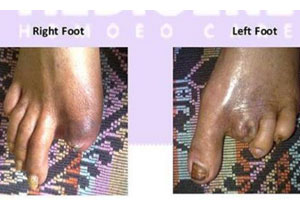
23.04.2014: The pain in the toe has improved greatly. The wound on the left foot is healing well. The right toe has fallen off, but the wound healing over the whole right leg is proceeding without problems. Sleep is better.
Prescription: Sac lac.
The patient walked to his appointment at our clinic today and is in excellent health.
Current health status
The patient’s blood sugar remains stable at 140 mg/dl, and insulin did not need to be increased. Blood pressure is controlled at 110/70. We advised the patient to see his doctors to have his medication adjusted.
**********************************************
This article was published on www.interhomeopathy.org
Photo: shutterstock - Despairing senior man on a dark background - 305651882 ©Photographee.eu
Category: Cases
Keywords: dry gangrene, diabetes mellitus, peripheral neuropathy, high blood pressure, exploited, suspicious, lead poisoning
Remedy: Arsenicum album

