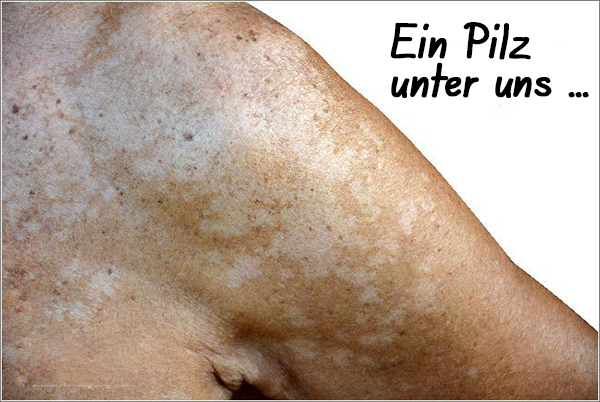
By popular request I recently wrote about fungal infections. (If you missed Part 1, you can read it here). Let us pick up where we left off last week.
Fungal infections discolour the skin
Have you ever met someone whose skin is discoloured as severely as shown in the photo above? Here in Florida we see that fairly often. But you must not jump to the conclusion that it only occurs more frequently here because people in Florida show more skin than elsewhere, for example in my home of Western New York.
No. This condition – also called Tinea versicolor – favours warm, humid climates.
During my time in India, when I studied alongside Drs. Prasanta and Pratip Banerji at the Prasanta Banerji Homeopathic Research Foundation, I saw this condition very frequently. To be honest, there are few climates warmer and more humid than India’s, and it is no surprise that this condition flourishes there.
The skin condition is caused by an overgrowth of a naturally occurring yeast that normally lives on the skin as part of our healthy skin flora.
So why do some people get sick and others not? In general, the cause of this yeast infection often has something to do with the local climatic conditions. The good news is that, in this case, the cause does not matter for our homeopathic remedies.
The Banerji protocol for fungal skin infections
The Banerjis very often prescribed their specific treatment protocol of Mercurius solubilis 200 (Merc sol), to be taken twice daily until noticeable improvement occurs.
And, as always when treating chronic conditions such as this, the remedy should be discontinued as soon as new symptoms appear or if no improvement is evident.
If the condition is accompanied by extreme itching (which is sometimes the case and sometimes not), the Banerjis’ recommendation would be to additionally take Antimonium crudum 6 and Arsenicum album 200 twice daily until the itching subsides. (For more information on potency and dosing you can read here).
The situation with ringworm is very similar. Ringworm (Tinea corporis) can be caused by over 40 different fungi. Although it occurs mainly in warmer climates, ringworm is most often spread by direct contact.
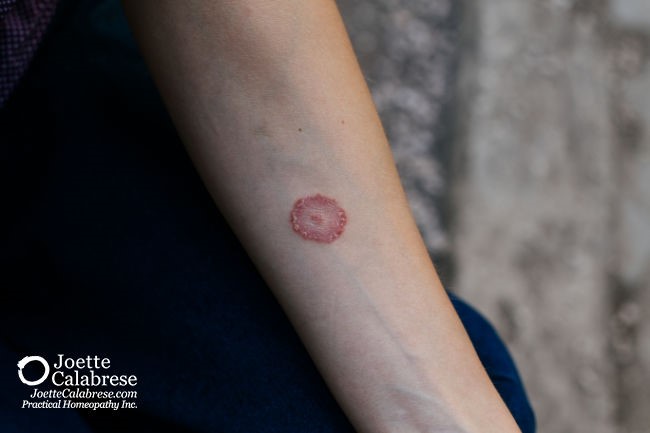
There are also appropriate Banerji protocols for this skin condition: either Merc sol 200, twice daily until noticeable improvement, or Graphites 200, one dose every third day until the rash has completely resolved.
Caution with antifungals
To the untrained eye skin conditions can be very difficult to distinguish and therefore a conventional diagnosis is always advisable. However, be critical when it comes to the prescription of antifungals that the doctor will insist on.
The doctors mean well, but they have never been to India and could not see how this condition can be cured with homeopathy. There are no unpleasant side effects, no undesirable reactions and no long-term consequences that may trouble you later. Homeopathy offers an elegant, reproducible and effective solution for your complaints.
Our everyday problems like the rashes described above give us the best opportunity to spread good news. Become your own hero – I will show you the way to the Banerji homeopathic method. Stock up your home pharmacy and be prepared for all eventualities!
Warmly,
Yours
.png)

