33-year-old man, first consultation on 7 January 2011
Main complaint: burnout syndrome
“I suddenly feel lost, have no motivation, nothing. I am not myself anymore. I used to laugh a lot and went out frequently. I have plans, I want to carry them out, but then I feel that I neither want anyone around me nor want to do anything. I feel as if I am missing out on everything.
It started about 3 years ago after a back injury. I had the feeling of a great loss, nothing was the same as before. I fractured several vertebrae and the sciatic nerve was pinched. I went to a chiropractor, had X-rays and saw a specialist who told me it was in the process of healing. It can have severe effects, pain when walking and moving, and when I walk around all day; lower back pain, pain in the buttock, in the left leg, and calf cramps.
About 10 years ago I lifted something that was too heavy; I tried to be a hero. For a few years nothing happened, but about 3 years ago it hit me really hard: I was out of action for almost 6 months. I couldn’t do much, I lost my physical strength, and even a simple walk was almost too much.
I have almost no motivation left. I am more of a daydreamer. I want to do this and that, and then it becomes too much and I do none of it, not even everyday tasks like housework. Last week, for example, it took me 4 days to go to the bank and pay a bill.
What do you do?
I just sit and think about life, what I could do, what I wanted to do; I lie there and think about it instead of doing anything. Something is missing or something has to happen, but I don’t know what.
I like fishing and camping. When I was still working, I often wanted to go out and fish for a while. I think a lot about social life.
At the moment I feel like a recluse. I used to be out and about and visit people, but now I don’t do any of that.
Please tell me about your childhood!
As a child I always had dogs and other pets. My parents were okay, they took us to the park and so on. My mother was good, but my father was violent. The kind of bloke who could sit at the table and suddenly strike someone for no reason or throw chairs. My brother and I were often beaten, mostly for no reason, we walked on eggshells.
Feelings towards your father?
I thought about it a few times: I loaded the .22 rifle and wanted to go upstairs and shoot him; everything was prepared – I would only have had to go up the stairs, but I never found the courage. I was aware of what would happen then, we would end up in foster care, I could see that far ahead.
When I was younger I was in quite a desperate situation. I was a quiet child and could occupy myself well; I had some friends, but mostly kept to myself.
As children my sister and I stuck closely together. We were very close, she was my little shadow, she didn’t suffer as badly as we did. Sometimes I took the beatings for my little sister.
And your mother?
When we were younger she was in the same boat as us, she eventually left him for a while. I don’t know the whole story, although I spoke to her about it when I was about 15 or 16. She couldn’t afford to leave him while she had three children to raise. She was also abused; she probably had it the worst, that’s for sure.
Your brother?
He never really stood up to our father, he tried to look the other way, but he got his share too.
How did you react?
I didn’t care about him, pushed him out of my thoughts. If I ran away he would still be there. If I ran away, the family would still get beaten. Everyone was too frightened to leave. That went on until I was about 15 or 16; then I suddenly changed and began to stand up for myself. My father still seemed threatening, but he became a grumpy old man.
How did you do at school?
I think fine. When I was younger my parents never had money, I never had nice clothes etc. I was teased a bit, but not too badly. I had a few good friends; occasionally there were problems. Kids are kids, childhood is part of growing up. If something bothers you, you have to do something about it. It didn’t affect my life.
How was your adolescence?
I smoked a lot of marijuana, I still smoke pretty much every day now, mainly in the evening; only occasionally do I get a bit high.
Originally I had planned to work for about a year and then go back to college and qualify as a mechanical engineer. But I never went back. At work I met many nice people and felt that this was a place where I was needed. For a few years I was happy with my job. When I was younger I never travelled much, so it was great for me to be paid to travel and see new places.
In recent years I had some downtime, before that I was usually away about 8–10 months a year. I was dependent on the money. Working is in my blood; I enjoyed the work and liked the people I worked with. For a long time it was: “This is my life and this is what I want to do.” Only since 2007 have I realised that life has a lot more to offer.
|
I now pay more attention to a work–life balance. From August to December I only had 4 days off.
I have no goals yet, I’m still looking for them. I just want to be happy and have fun all the time, lead a healthy life. I would like to spend more time with other people, with friends, with family, attend gatherings and get-togethers etc.
I’m always out of breath, I smoke too much. I don’t drink enough during the day. I literally have to force myself. I have stress at work, my whole life revolves around work.
What do you do when you feel stressed?
I take a short drive and put my foot down. Maybe I talk to someone at work about it to let it out. In 80% of cases I go for a drive to calm myself down. I can’t sit in front of my coworkers and take deep breaths.
Is the stress due to your leadership position?
At first it was very stressful, I had taken on too much. I found it hard to say “no”, which isn’t good. I always look after everyone else first and try to help them before I go to my own work.
Do you have leadership qualities?
I liked it, we were a team – I love challenges, that’s for sure.
Sleep?
Some nights are okay, but most nights I toss and turn in bed, wake up, get up a bit, go back to bed, and don’t get enough sleep. I wake up in the morning and don’t feel refreshed. I’m stuck in my work.
Dreams?
I could never really remember my dreams. I dream a lot about my work, what will happen the next day or whatever.
At the end of the consultation he says: “Where has my life gone?”
Patient’s colour choice: 21 C
Analysis
The rubric “Mind and disposition, desire to kill – parents, his, in a child” has only one remedy: Derris pinnata.
I thought this was important in this case, together with other themes that belong to the iron series. There are also many similarities with the Leguminosae. I was of the opinion that a plant remedy was indicated, as the injury some years ago was clearly the cause that led to the current state.
Themes of the Fabaceae reflected in this case
- Dreams of work (Baptisia)
- Poverty, fear of poverty
- Duty, working too hard
- Butterfly-like: desire for freedom, wanting to escape a difficult existence
The theme of poverty is widespread, the fear of not having enough to meet one’s needs, both on a physical and an emotional level (cf. Psorinum). Life is experienced as laborious and boring, joyless and without variety. Everything is hard work and not play. Patients who need Fabaceae feel helplessly exposed to poverty and lack. They tend to overwork and in doing so become dry, humourless, disappointed and critical ("holy bean").
Jan Scholten notes that the Fabaceae (legumes) are important remedies in chronic fatigue syndrome. The fatigue is both physical and mental. Physically it can lead to real paralysis (multiple sclerosis, polio) or the opposite of paralysis, namely epilepsy. Mentally the condition manifests as lethargy and confusion, inability to concentrate or to think at all. In short, the overall picture is marked by distress, suffering and a sense of doom.
The logical consequence is the craving for pleasure, the wish to enjoy life without the burden of problems.
Fabaceae remedies may be necessary when someone has experienced their whole life as hard, or they may be helpful in particular life phases when there is only work and no pleasure.
According to Jan Scholten, Derris pinnata is in stage 15, in the tubercular miasm, with themes of loss, sudden feeling of being lost, desire to travel, breathing difficulties, and loss of life energy.
Prescription: Derris pinnata C6, daily
Follow-up after one week:
(The patient reports that he now has no pain, neither when getting up nor during the day.)
I have a bit more initiative. I no longer just think about doing something. For a few days now I’ve been working in my department. I have more energy again and I’m not so extremely tired in the evenings. Strange: I sleep less and have more energy. I sleep through the night. I still don’t have dreams. When I do dream, it seems to last only 2 minutes. I keep seeing the sea and the bright sun, so peaceful. I sleep much better, and it’s not even difficult to get up in the morning. In the last two days I’ve been getting up at 6 am.
Follow-up after 2 months
I sleep through the night. In the morning I’m only tired for a minute or two, then I get up and my energy is pretty good. I got myself a dog; he forces me to walk, which gives me good energy. Energy and motivation have improved a lot compared with before; I no longer sit and think about things. Most of the time I get everything done that I need to in a day, which is great.
Back pain?
It really seems to be getting better. Apparently I no longer have pain. Even getting up in the morning I don’t have pain anymore, and it’s like “wow!” The sciatica pain is also better; the sciatic nerve reacted slightly when I began to take long walks and hikes with the dog. I was surprised when I visited C. last weekend: I was on an indoor playground for hours and had no pain at all, which is amazing. It’s as if I’ve started a new life. I feel that I can do a lot more again; life is coming back! It feels as if there is a little more fun again. I feel like a child again; one day I planted a tree, and it was fun and brought back old memories.
Shortness of breath?
No longer so often, since I walk, it doesn’t catch me as often; it’s more the exception.
Follow-up after 4½ months
I’m really well, it’s a huge difference. I sleep less, but I feel rested and ready for the day. I have much more energy and manage what I need to do in a day. My breathing is wonderful, I can now walk uphill with my dog. I still smoke, but my eating habits have become much healthier (I have lost weight). Everything has developed positively, the treatment was very successful! If I feel a bit down, I notice what’s happening and don’t fall back into a depression. Then I take another dose (C12) and the next morning I feel fine again.
Follow-up (email) after 15 months
All healthy and well here. I still have a few globules from the first time you sent them, I take them when necessary. My energy is a bit variable because some people have come into my life and then left again. This winter I had a new roommate; he stole from me while I was away; that bothered me for a while. But as soon as I took the remedy, my energy returned and my mind cleared again. My back has improved; therefore I can work more now, and that keeps me moving. I now sleep better. I go to bed at 11 pm and get up every morning at about 7 am after a restful night’s sleep.
Katharina Riedener practises in Osoyoos, B.C. (Canada)
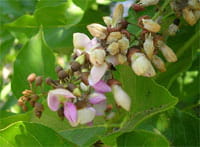
Photo: Wikimedia Commons
Pongama pinnata; L.Shyamal
Category: Cases
Keywords: chronic fatigue, unmotivated, desire to kill, fear of poverty, Leguminosae
Remedies: Derris pinnata
|